Showing posts with label Andrey Kurkov. Show all posts

Sunday, 16 December 2012

Puppet Shows - small and absurdly formed

Puppet Shows by Michael Frissore (Writers AMuse me Publishing: 2012). A collection of short stories by a writer the Tuscon Weekly describes as “a very funny weirdo”. All of them are bizarre, and feature sock puppets regularly.

Last week, I got a bit grumpy at Kurkov. I fell a bit in love with his dry absurdity a few years ago, and felt he’d sullied what we had by trying to drag it out over a full length, epic novel. Such Tom-foolery doesn’t seem to be able to hold attention for long periods.

It’s like the original Star Trek in that way - fun and intriguing, but ultimately a bit boring if you’re forced to watch it for a full hour. (Yes, I’m very definitely on Team Picard, not Team Kirk. Unless you’re talking about the modern Krik. But I digress…)

So, in the search for something new and fresh and absurd and short, Twitter told me to pick Puppet Shows up.

Like a lot of Twitter suggestions, this is not mainstream fiction. It’s not mainstream anything. This guy is weird, and the stories he tells are every bit as bizarre. But from page 1, they’re fun. The stories are so far off the wall they’re in the garden somewhere.

Frissore should be praised for more than just his sense of humour though. There’s an incredibly fluent turn of phrase here; you can hear every word smoothly, without effort. The language is spare in places, but often lively and always interesting. It’s conversational, but if that conversation was being held by the two sharpest, wittiest people you know (who also happen to be loony tunes).

I don’t know if Frissore bangs this stuff out without sweat, or if he agonises over each syllable, but the effect is prose that’s as rewarding to read as it is funny.

There are sacrifices for such spoonfuls of farce, though. Lay your self down on such a silly alter, and there are things you have to throw out the window. For example, believability, and with it any lasting connection with characters.

In his zeal for the absurd, Frissore also slips into a random-word-generator trap sometimes. There are elements inserted sometimes simply because of how out of place they appear. It only sticks out very occasionally. For the most part, Frissore manages to keep these in the realms of relevance, but occasionally my eyes rolled ever so slightly at attempts to insert a wacky ingredient.

It’s a difficult plate to spin though, creating something both worthwhile and absurd. And in many of these stories, Frissore nails it. One or two heart strings are even plucked subtly, with a three word flash of emotion dropped in amongst a chaotic tale.

But let’s not take for granted the most important point - the funny. Every story amused me, and all of them were cut off at just about the right time. There were one or two which could even have been longer. After Kurkov’s long disappointment, Frissore reaffirmed my belief that such whimsy (that’s right, I used the word whimsy, what of it?), screams loudest and most perfectly in rich, short bursts.

8 GBR

Really fun.

Next week, it’s the GBRYIR (Gav’s Book Reviews Year in Review). I know it’s the highlight of your Christmas. Don’t even try to deny it.

Sunday, 9 December 2012

The Milkman in the Night - I was not grabbed. I was barely pawed.

The Milkman in the Night by Andrey Kurkov (Harvill Secker: 2011 - first published in Ukraine in 2009) A series of interweaving stories based in modern Ukraine, involving a resurrected cat, an anti-wimp drug, an underground cult, unexplained sleepwalking, an embalmed husband, and lots of milk (though not necessarily in that order).

That sounds a lark, eh? All those bizarre plot ingredients. Ripe for a bit of Andrey Kurkov fun, I’ll bet.

That’s exactly what I assumed. I’m a Kurkov fan. I enjoyed Death of a Penguin. It was short and almost perfect. So this seemed worth looking forward to.

I probably should have left it there. But I had to go and spoil it. I had to wade into another Kurkov which, from the outset, warned me it was going to be different. It was longer than any other Kurkov I've picked up, which was a red flag to start with.

It's not entirely different, I guess. There are still many of the hallmarks I loved the first time around. The Milkman in the Night has a similar sense of humour as Kurkov’s previous writing. His feel for the absurd is still there, and he continues to make you feel something approaching warmth for his simply presented, innocently motivated characters. They’re almost two dimensional at times, but it gives them a strange sort of appeal. Not quite pity, but something in the same family.

So he played around with the same ingredients, and he did so through a handful of cleverly interlinked stories. 

But no! I have to stop myself there. I’m in danger of persuading myself this wasn’t that bad after all. It wasn’t terrible, but it wasn’t great either. There were sections where I got bored, which is pretty much the one sin I find tough to forgive in a book.
With the possible exception of Irina, I struggled to care what happened to each of the characters. Trying to sustain the sort of farcical story lines Kurkov is so expert at weaving through a long novel like this is an incredibly tough ask, and not one I think The Milkman in the Night answers very successfully.

I just didn’t enjoy this. I can sit down and I can tell you all the reasons why this should be good. I could tell you the bits I did enjoy. I could laud his humour and the serious points that lie underneath it. I could probably sell this book to you if I put enough heart into it. But none of it escapes the fact that at no point was I tempted to stay on the train for an extra stop to read a bit more.

It provides a complete counterpoint to JK Rowling’s latest mega-book in a lot of ways. With The Milkman in the Night, I should enjoy it but didn't. With Rowling, I’d struggle to tell you exactly why I enjoyed The Casual Vacancy. I shouldn’t have. But I did. Rowling’s story telling prowess compelled me, and I looked forward to picking it up every chance I got.

That didn’t happen with this. I was amused. At a couple of points, I was touched. But for a 474 page book, there needs to be a whole lot more than that. It needs to make you care. Compel you to read on. It needs to grab you in a way that sustains you through each turn of the page.

I was not grabbed. I was barely pawed.

5 GBR

Good bits, but not enough of them.

Next week, a complete surprise (mainly because I have no idea what it’ll be yet. I have six books all staring at me waiting to be read - I may have to flip several coins).

Sunday, 25 November 2012

The Hundred Year-Old Man Who Climbed out of the Window and Disappeared - maybe the title's too long?

The Hundred Year-Old Man Who Climbed out of the Window and Disappeared by Jonas Jonasson (Hesperus Press: 2012). A bizarre tale of a man who traversed the 20th century, inadvertently influencing world events as he goes. As he turns 100, he escapes from his own birthday party to embark on a last adventure, involving a criminal gang, a suitcase full of money, an elephant, and multiple murders.

I’m never sure with translations. I’m a mono-linguist - I can order a cup of coffee in
Germany, but that’s about it. So I have no idea how the process of translating a book goes.

Surely the translator takes on a lot of responsibility for tone and style? “Feel” is an important (if unhelpfully vague) characteristic for a book. How do you make sure you’re getting the same one in both languages? How do you make sure you achieve in English what the writer was going for in Swedish?

I bring this up because as far as “feel” goes, I loved this book. It reminded me strongly of another writer who also relies on translation - Andrey Kurkov. Both Kurkov and Jonasson write with an incredibly spare, matter of fact, short, punchy, frank style. I love it. It’s unadorned and achieves an innocent effect.

It fits perfectly with the straightforwardness of the main protagonists, and it contrasts neatly with the surrealism of the story lines - the bizarre twists and turns. Nothing is heralded with a chorus of trumpets. Everything is simply related as if it’s the most ordinary tale in the world (though of course it’s not).

But are Kurkov and Jonasson two writers with the same style, or do they just have similar translators? Or maybe Swedish and Ukrainian are simply very economic languages, and all Swedish and Ukrainian books are like this? Somebody could probably tell me the answer, but as of right now, I do not know.

I probably shouldn’t care. I should probably have stopped at “I loved this book”.

Whatever the reason for the style and tone, it grabbed me and it didn’t let me go. It’s a long-ish book (around 400 pages), but it didn’t grow old for me (pun entirely intended). I smirked every time Allan Karlsson got out of a tight corner with nothing more than a brand of naïve logic. I was intrigued every time he met another world figure without showing an ounce of awe. I grew fonder of him every time he related his incredibly simple outlook on life. His quirks and the quirks of those around him entertained me from beginning to end. The end itself was perhaps a little drawn out, with Jonasson continuing to mutter on for a few pages after the story itself was clearly finished, but I'll forgive him that.

I know people who disagree. I know people who got irritated with the lack of plausibility. People who feel this is a book with a neat trick which it plays far too many times. And I can see their point. That’s the problem with absurdity - it can have a short shelf life. But tell that to Dickens and the Pickwick Papers. Tell that to Evelyn Waugh andto  P.G. Wodehouse. If it’s done well, a little farce can go a long way.

I really enjoyed Andrey Kurkov when I first found him. Jonasson seems a pretty close contemporary of his. OK, so I don’t have the same feel that I’ve uncovered a hidden gem - this book has been in the hand of a lot of commuters in the last few months. But that didn’t take the shine off for me.

Bottom line - I enjoyed reading this, and I hope you will too.

8 GBR

Deserves at least as much as Death and the Penguin.

Next week, I may have to enny-meeny-miny-mo it. I have another Kurkov lined up waiting to be read, and Tom Wolfe is staring at me menacingly from my book shelf as well.

Sunday, 7 August 2011

Death and the Penguin - quietly brilliant

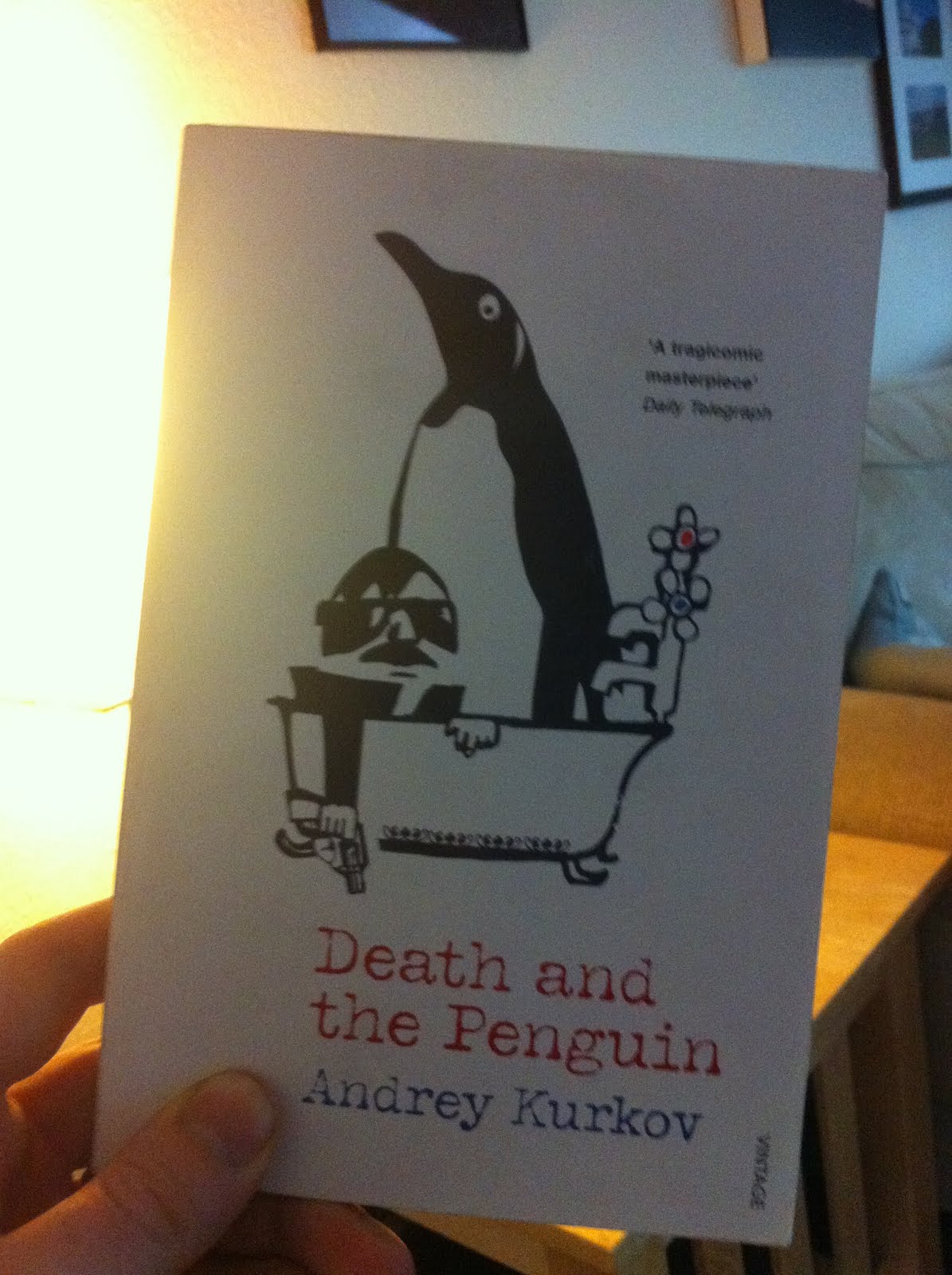
Death and the Penguin by Andrey Kurkov (2001: The Harvill Press) Set in a Ukraine that’s in the process of rebuilding itself, this book follows a struggling writer as he unwittingly finds himself embroiled in the world of organised crime, shadowed all the while by an unlikely sidekick – his pet penguin Misha.
A Ukranian book. About a writer. His depressed penguin. And the Mafia.
Well, that sounds a bit different doesn’t it? It was enough to make me want to pick this book up. It’s been a year or two since I read this, but it’s kind of stuck with me. I haven’t read anything like it since. I even tried another book by the same author, but it didn’t quite hit the same notes as this one.
Its major plus is the way in which it lets you discover it. From the first page, you’re given a sense that you’re uncovering something brilliant. And it doesn’t shout at you, it doesn’t jump up and down waving its arms in the air saying “hey, I’m a great little book, feel free to marvel at my brilliance.” Kurkov’s style is so incredibly understated that it has a very honest quality. It’s written in such an uncomplicated way that it ends up almost whispering the story to you, and you’re left feeling like you’ve been let into a pretty special secret.
And it’s funny. It really is. You’re not left doubled up in hysterics, but the surreal storyline and the dead-pan delivery ends up being funny in a really warm way. The story and its characters just stand there on the pages, looking at you expressionless, puzzled by the bizarre circumstances they’re surrounded by, and you can’t help but find their simplicity both endearing and funny at the same time.
Downsides? Well, for all the positive qualities of the stripped down writing style, it also comes with the inevitable negative of feeling a little thin sometimes. You never feel like you’re really biting into anything with much weight. And for all its comic qualities, you do end up feeling in places that it gets a little too convoluted. Only once or twice though, and it’s not enough to detract from the overall entertainment of this book.
The penguin is the star of course, and the book ends up taking on the qualities of the animal. Inherently funny, very simple and honest, quirky, heart warming - but held back a little by its unavoidable silliness.
8 GBR
Definitely worth a read. Very different and very enjoyable.
Next week, another change of pace (because I know you get bored easily). GBR will move from post-modern Ukranian chic to a classic English saga.
Try to behave until next Sunday.