Showing posts with label 7 GBR. Show all posts

Sunday, 21 April 2013

Snapper - welcoming cuckoos


Snapper by Brian Kimberling (Tinder Press: 2013). Nathan Lochmeuller is a man without motivation, and essentially falls into a job tracking song birds in a square mile of Indiana forest. He enjoys it, whilst his life and the world change around him. The novel skips between his youth, his adolescence and his grown-up years, all circling around the time he spends getting paid to watch birds.
You’re sitting with people you’ve grown up with, and you start reminiscing. Natural, right? You rehash conversations you’ve had fifty times, and you’re hilarious as you retell jokes only you guys get. It’s repetitive, but it’s comforting and indulgent. And, most importantly, you’re hilarious.
Then someone else enters the group. Some third party, unaware of how hilarious you are. You instantly get highly self aware. You glance at the cuckoo and realise how all this must sound through their ears. Boring. Irrelevant. If nothing else, you’re definitely not as funny as you thought you were.
Shared experience is fun to retread purely because it’s shared. The cuckoo wasn’t there though. To them, that time your mate got drunk and cut his hand is not the pinnacle of comedic endeavour. It’s dumb. I give you exactly ten minutes before the cuckoo’s eyes glaze over and they start planning an escape route.
That’s you and me though. That’s normal people. Brian Kimberling on the other hand – he’s a writer, and a pretty good one. He spreads out over 200-odd pages the formative experiences of Nathan Lochmeuller’s life. His own childish and adolescent and adult anecdotes. On the face of it, they’re pretty unremarkable. Kimberling sits us down opposite him, buys us a pint, and recounts vignette after vignette of experience in a life lived in Indiana.
This right here, this is the magic of story-telling. In the real world situation, the only way to make the cuckoo feel more involved is to change the topic of conversation to something they can more relate to. In Snapper though, Kimberling ploughs on, rambling his way through the narrative, dragging you deeper and deeper into Indiana.
Course, it’s not magic. There’s method to it. There are courses and workshops and entire traditions which show you how to do it. Kimberling draws on all this, no doubt, but he’s an artist, and what he achieves is remarkable. He makes sure Nathan Lochmeuller is witty and likeable (albeit a bit of a loser). He makes sure to reveal a beautiful and ugly Indiana. But most importantly, Kimberling injects meaning into each little experience he relates.
He does it subtly, but there are signposts and careful exposition; just enough so you know you’re not just reading about stuff that happened to Nathan Lochmeuller. This isn’t just a novel-length explanation of his life to date. Rather, in amongst it all, you see a search for worth in the world. A man with paths to choose but no belief in any of them. The beauty of simplicity.
That’s what we’re doing wrong, down the pub, when there’s a cuckoo in the group and our stories are boring them. We’re failing to explore meaning-of-life type questions through our experience.
I knew I was doing something wrong.
7 GBR
A gorgeously written, warm novel. It didn’t blow me away, but it did make me stop and think.
Next week, something a bit heartbreaking (if the book’s preamble is anything to go by).

Sunday, 18 November 2012

Astray - short story tastic

Astray by Emma Donoghue (Picador: 2012) A collection of short stories by Irish writer Emma Donoghue. All based on real people and real events, Donoghue shines a light onto the lives of a series of people who have all gone astray, crossing borders of nation, sex, race, law, sanity, etc.
Read the GBR interview with Emma Donoghue here.
She does a good job of making you pick a book up, Donoghue. The only other of hers that I’ve read, Room, had such a compelling premise that I fair sprinted to turn over the front cover and get going. Astray, too, has an intriguing sell – a series of historical fiction short stories, all focussing on people who have strayed beyond the boundaries of ordinary life in some profound way.
I like that.
And I like that this is done as a collection of short stories. It seems apt. Little snippets of lives, one after the other. It keep you a little dislocated as you’re going through it. You don’t spend days and days in the company of single stories, getting comfortable with motivations and setting. Just as you feel you’re starting to understand the meaning behind the latest tale, Donoghue whisks you away to the next.
It’s a showcase for Donoghue’s talent as well. Each story is distinct. Each voice authentic. Short stories they may be, but Donoghue gives a complete picture of each person she tells us about. Sometimes she does it through careful description, and sometimes she does it by simply writing in such a true way that the language gives you a distinct feel for the people.
I’m piling up points in the pro column here. The plots should go there too. Donoghue has corralled such a disperse but vital set of outcasts that each story grabs, often in different ways. There are explanatory notes at the end of each story and at the end of the book, constantly reminding us these tales are based on real people and real events. She shows where she takes artistic licence, but pushes home the point that the crux of these stories and the lessons she tries to show through them are real.
That’s the fascination of historical fiction. It may be dramatised and it may not be 100% real, but enhanced or not, the lessons are the true. And Donoghue has done a good job of picking some honest to goodness fascinating episodes, and enhanced them beautifully with her own talent.
So those are the pros. I’m going to paint myself out of the corner though. A little, at least. I got to the end of Astray and was desperate to pick up a novel again. I love short stories when in the mood, but reading a collection from beginning to end tends to leave me with a need to invest in something more substantial again. Not Donoghue’s fault, more a weakness of the format, but true all the same.
And then there’s the living-up-to-the-premise challenge. It was the major problem I had with Room (though that kicked in with an 8 GBR). And I recognised it again here. Astray promises to show us a diverse range of characters with a common theme – they’re all astray in society. I struggled to follow the common thread though. There was such an opportunity here to tie these stories together so much more than they are. It would have helped overcome that short story weakness I mentioned – the feeling you’re never investing in anything chunky. But as far as I could see, the opportunity was missed.
The stories were too disparate. The structure suggested by the title of the collection and the blurb on the dust jacket seemed a little manufactured, a little imposed. I enjoyed each individual story, some of them immensely, but I felt short changed there wasn’t a wider arc around them. A wider meaning. When I interviewed the author, she mentioned the stories were written over many years.  This made sense. It felt like they were all picked up and then a common thread was looked for, rather than written with the wider structure in mind.
Which is all a little harsh. The con column at the moment has only two things in it – one is a weakness of all short stories, and the other is a weakness of composition. The individual stories in here are incredibly strong. But both cons were enough to leave me feeling just ever so slightly flat by the time I turned the last page.
7 GBR
Donoghue is an amazing writer. Really she is. I like her a lot. I might go back and read some of her earlier stuff. And Astray  is really good, but falls short of amazing.
Next week, a book I’m reading on the recommendation of a GBR reader. So if it sucks, it’ll be your fault.

Sunday, 8 July 2012

Slaughterhouse 5 - skinning cats


Slaughterhouse 5 by Kurt Vonnegut (1970: Jonathan Cape). An anti-war novel of the original anti-war age. Kurt Vonnegut introduces us to an American who flits forward and backward in time. We see him alternately as a middle aged optometrist, a captive in an alien zoo, touring the country as a revolutionary speaker, and watching Dresden burn in WWII.
There’s more than one way to be skin a cat. Odd phrase. I’d like to know who came up with it, and then make sure I don’t ever get too close to them. But it’s true, all the same.
Last week, I went on about DBC Pierre’s language. About its decadence and its beauty.
Kurt Vonnegut achieves beauty in a different way. Not for him the flurries of luxurious inspiration. Instead, his writing is stripped back to the bare bones. Clipped, economical sentences. Simple phrasing. Worlds and lives laid out in the bare minimum of space.
It’s difficult to do. It shows a great deal of restraint and ingenuity. High levels of concentration and a commitment to perfecting every sentence. But the result is worth it. The result is a book with a relentless rhythm.
For all the simplicity of the language, the plot provides a direct contrast. It’s intricate and fantastic. The protagonist is a time travelling optometrist who suffers alien abduction and learns a radical new way of experiencing life. He also trips through World War II in an increasingly absurd outfit.
And then he watches Dresden burn, and picks through the aftermath.
The whole book is set up to make the horror of Dresden scream out. It’s not mired in pathos. It’s couched in ridiculousness. More comedy than sentiment. The point is clear – it’s all a bit pointless. All the death and suffering and ruined lives – none of it serves a higher purpose. None of it is necessary. None of it has any wider meaning.
It’s an original way of making a well worn point. And you can see why it had so much impact when it was written. It doesn’t whine. It simply takes the bloodshed and surrounds it with an absurdity that leaches into every corner of the book.
It’s good. It’s a classic and it deserves to be.
But (crucial question) did I enjoy it?
Yes, but not outrageously. It’s clever, and it’s original, and it’s compelling in places. It still has relevance. But I didn’t fall off my seat when reading it. I wasn’t blown away like I was with DBC Pierre last week. All the power of the simple language, all the imagination; it raised my eyebrows and it made me think. But it didn’t make me howl.
I was impressed. But my socks remained firmly un-knocked off.
7 GBR
Good solid score. If you haven’t read this, you should. It’s a short read, and a worthwhile one.
Next week, a modern western. More new territory.

Sunday, 20 May 2012

The Hunger Games - going off-road

Our copy is out on loan, so I
had to steal a pic from Amazon.
Sorry, Amazon
The Hunger Games by Suzanne Collins (Scholastic: 2009) In a post-apocalyptic America, children are forced to fight to the death by an all powerful ruling elite. Their battles are the reality TV event of the year for a blood-thirsty public. But when Katniss Everdeen, a 16 year old from one of the poorest districts, enters the arena, her battle to stay alive puts her on a collision course with authority.
I tried to write this last Sunday, but gave up. I got half way through, then slumped. I read what I’d written, and decided it was best for everyone if I just shut the lap-top and walked away. I saved you from one there. It stunk.
I found it tough because I wanted to make a point with it. But it got a bit preachy. A bit shouty. So let’s try again.
I’ve had a couple of comfortable GBR weeks. Glen Duncan followed by PG Wodehouse. Safe and safe. Time to off-road a little. Step up, young-adult fiction (or YA to those in the know).
You’ve heard of this book. It’s no point denying it, I know you have. It’s one of those cultural phenomenon things. You don’t know where you heard about it first, but it’s come into your life. And for most of you, it’s forced you into a choice. Open the mind, give something new a go, try to understand why millions of fans like it. Or go the other way, judge the book by its cover, assume YA fiction isn’t for you, and look down on the millions of fans that have gone a bit potty about it.
See what I’ve done there. I’ve painted one of those as the good choice, and the other as the bad choice. Not subtle, I know. But you should have seen my first try last week. You’ve got off lightly this time around.
Let me be clear – I’m not a YA cheerleader. But I am a fan of trying new stuff. Haven’t always been, but I am now.
The Hunger Games goes to the movies
Here’s a book, a franchise, that’s exploded. It’s spawned at least one box office smash, and has the kind of devoted fan base that is difficult to ignore. There must be something to it, right? At the very least, it’s worth reading to find out for myself. Ignoring it as a kid’s book, as a genre that’s not meant for me, as something unworthy – that’s too easy. It’s won too many people over and has too many intelligent defenders (Mrs GBR amongst them) to dismiss it like that. It’s earned a look.
And, having looked, I confess - I enjoyed it. That’s got to be the first (and probably most important) thing. I resisted a little, but I was gripped. I knew the basic plot and setting going in, but that didn’t make it boring. Collins keeps you uncomfortable from the beginning to the end, never lets you get to grips with the world she’s created.
Which is a good thing – it means you slurp up page after page in your quest to get your head around it all. It means the whole environment of the book is fascinating. Despite myself and my cynicism, I did start to care about the characters and their fates. I did start to react to the bad guys. I did feel the unfairness. I became tense in all the right places.
There’s the YA flavoured downsides too though. There’s a lot said about the “darkness” of this series, about the macabre concept of kids fighting to the death. And yeah, it is a dark idea, but not one that Collins ever really succeeds in making pitch-black dark. She could have gone gothic with it, but the teenage girl voice that drives the narrative holds it up. The idea and the events made me uncomfortable (which, like I say, was a good thing), but the constraints of the genre stopped it ever making the leap to disturbing believability.
Collins also tries to create knots of moral ambiguity, of complex questions, but it’s all set against a simplistic back drop of good vs evil. There are the instantly recognisable good guys (with their love for each other and strong sense of right and wrong) and the cartoon bad guys (with their complete lack of empathy and their blood lust). It’s a lazy formula, and one that skips any attempt to understand where the good and the evil comes from.
There’s the clumsy love element to the story too. And it really is clumsy. Maybe it’s because I was never a teenage girl, can’t identify with it, but there were bits that had my eyes rolling until they could roll no more. And it’s not because I’m unfeeling. I’ve read books about love and been moved by them. But not here. Here, it’s cutesy and rose-tinted.
But that’s what this genre brings. Young adult books are written for young adults, so there are always going to be bits that jar for the rest of us. But if you can get over that, there’s plenty for adults too, especially when they’re as well written as this. The Hunger Games world really is incredibly constructed. The plot has a rhythm and direction that you can’t help but get on board with.
I raced through the book, and kind of want to pick up the next one. I enjoyed it. It brought out reactions from me. I can forgive it its young-adult flaws, because it had the best of the genre too. It had excitement. It had imagination. The pages practically turned themselves.
7 GBR
Classic fence sitting score.  I haven’t quite drunk the YA cool-aid, but I’m getting thirstier. I can say hand on heart there were parts of The Hunger Games I hugely enjoyed.
You should definitely read this. Some of you will love it. Some of you will just quite like it. And some of you will still end up hating it, but at least you can say you gave it a try.
Next week, something that will hopefully make me less preachy.

Sunday, 25 March 2012

Metamorphosis - the cockroach in the room

Rubbish picture this week, as I'm
in Essex, sans camera. Soz.

Metamorphosis by Franz Kafka (originally published 1915. My copy is from Penguin Modern Classics: 2007) A short story of a hardworking man who finds difficulty supporting his parents and sister when he finds himself turned into a cockroach.

Kafka is a name I’ve only really become aware of in the last few years. Slowly but surely, you’ve started to hear his name uttered here and there. Maybe I’ve just been in the literary cold for most of my life. It’s not like I ever go too far out of my way to find stuff, and my formal education pretty much started with Lord of the Flies and finished with Seamus Heaney (and didn’t make too many major stops in between).

So I thought I’d give him a go. And if you’re going to give someone a go, then you might as well start with what they’re most famous for, which I’m reliably informed by the blurb at the start of this book is the short story entitled Metamorphosis. It’s tucked in amongst a bunch of other short stories in this book, many of which I read as well, but let’s focus our attention on that one, eh? Makes this thing a whole lot easier on us both.

First things first; it’s bizarre. Properly bizarre. You’re landed right from the first sentence in a world where someone can just wake up one day as a cockroach. There’s a certain amount of confusion, disgust and embarrassment (naturally), but not really any disbelief. More like the guy has just woken up and all his hair has fallen out. Inconvenient, but not something to call the national press or police (or whoever else you can think of) about.

It gives the whole story an edge that works really well (something he does in a lot of his writing, but I promised not to talk about that, so I won’t. Disregard this whole bracketed section immediately, unless you want to turn me into a liar). You’re suspended in a constant state of what-the-hell-is-going-on-ness throughout the story. Kafka never really lets you off the hook from that feeling. He explains in excruciating and sometimes graphic detail the problems of the situation, the feelings of isolation, the discomfort, the changes in relationships - everything. But he ignores the most obvious questions. Why? How?

Got to assume that’s on purpose. I mean, you don’t write that someone’s turned into a cockroach and just forget to explain how or why. Kafka presents a reach-out-and-touch-it world, populated with solid people (and one giant cockroach). He relates the story of a man and a family, beholden to work and duty in a way that plucks one or two heartstrings (fairly gently). By concentrating on those sorts of factors, and ignoring the elephant in the room, the story has more life, more tension. If it was just about the “why” or the “how”, then I’d probably lose interest.

Downsides? I get nervous here, to be honest. It’s Kafka. One of those I don’t really feel qualified to criticise too much. But I will. The language is a little grey in places. And the main character (Gregor) changes quite a bit. I was never sure if it was intentional, and supposed to signify the effect of his metamorphosis, but I just felt his personality swung a bit too violently. His reaction to some things came off as unrealistic, and his opinions seemed to vary from one page to the next. I’m sure this was all done on purpose, but the pace of it stopped me sympathising and identifying with him in any real way. And I’m not interested in a hero that I can’t connect to in at least some small way.

Kafka, on the GBR scale?

7 GBR

Really interesting read. A different one. And only a short story, so why not give it a go. And while you’re at it, pick through some of the other stories on offer in here.

Next week (if I finish it in time) a modern Hungarian book that is apparently “Kafka-esque”. I now know more about what that means. Gold star for me.

Sunday, 18 December 2011

Lanark - epic

Lanark by Alasdair Gray (Canongate: 1981). A semi autobiographical epic work of fiction, in which we follow the tragic life of a flawed artistic genius in Glasgow, and then continue to follow him after he dies and stumbles his way through Gray’s version of hell, also sort of recognisable as Glasgow.


How do you blog about an epic? Here’s a book that’s taken this guy the best years of his life (30 odd of them) to finish. He’s put himself into it in pretty much every way imaginable. He’s lived with it and grown with it and become obsessed with it for decades. It landed in the world to critical acclaim and has gone down in history as a seminal novel (at least if you believe the introduction).

And here’s me, trying to reduce my opinion of it down to about 500 words (ideally less. I know how you like brevity).

So let’s make this simple. Did I enjoy it? Yes, I’d have to say I did. It has so much in it that it’s hard not to find at least something to like. From the surrealism of the hellish world that the author spends the start and end of the book in, to the everyday majesty of the middle sections. From the hopping around between timelines to the room given for an array of beautiful characters. From the heartbreak of ordinary people, to the flamboyance of the extravagant.

It’s all here. There’s variety in abundance. But there are some unifying threads too. The language (especially the dialogue) is very simple and stripped back. All the stages are vivid and painted with enough care but not too much. The honesty of the protagonist is constant (whichever world or incarnation he finds himself in) and the complexity of those around him remain intricate throughout.

There’s just so much here! And that may be the main (though probably not only) drawback of Lanark. This isn’t a book to flip through on a plane. It’s a book that you need to make room for in your life, and commit to in a fairly serious way. If you don’t, it will quickly turn into a bit of a sand pit. The best moments I had with Lanark were in quiet places, where I had an hour or so to sit down and focus on the pages in front of me.

Don’t give it space to breath, and Lanark won’t just become a drudge to get through, it’ll become downright confusing. The imagination that’s been poured into here comes with about three extra shots of espresso and seven sugars. It’s not overstating it to say it’s wild in places, and it remains wild unless you pay it the proper attention. If you do, you’re rewarded with a sense of structure and purpose that co-exists with the wildness.

I could write about this one for ages. But I’m betting you’re starting to get bored now, so I’ll get to the point.

Lanark is a great book, no doubt. It’s about as rich as they come, and it’s original, and it’s important.  But it’s only those things in the right circumstances. In the wrong circumstances, it’s confused and disjointed.

Difficult one to score then. I’ll put my finger in the air, and come up with a…

7 GBR

Pick it up if you're serious about it. It's absolutley worth your time. But if you're not, don't bother.

Next week, it’s CHRRRIISSSTMAAASS! So not sure if I’ll get around to a blog. If I don’t, I’ll definitely be doing a round up of the year though. So stay tuned. And feel free to let me know some of your highlights of the year, either as a comment to this post or to gavsbookreviews@hotmail.co.uk or tweet me @GavCollins9.

You know, if you want to.

Sunday, 6 November 2011

The Sense of an Ending - award winning believability

The Sense of an Ending by Julian Barnes (Jonathan Cape: 2011) A short novel written in the first person. Tony Webster looks back on his life and the few key relationships that shaped it, memories triggered by the fate of one of his closest and enigmatic friends.
Got to try the big award winners, right? These are the books that all the pros reckon will end up being the lasters, the ones that survive time and end up being remembered. According to those in the know, these books are the best of the best of what’s around today. That’s why they give them the prizes (obvs).
Once a year, the Man Booker Prize is given out, and the book it’s given too presumably enjoys an ugly upward spike in its sales for a few weeks. I usually do my bit to contribute to that spike (it's nice to take part), the more so this year as the winner was a novella, so a quick read, which I like.
I’ve read a few Man Booker Prize winners (even reviewed one of them here), and they’ve all been quite different from each other. Which is good. And which happened again this time.
The Sense of an Ending has a really simple premise. A man looking back on his life, questioning the reliability of memory, the nature of history, and learning new things about himself and his past.
So simple in fact that it has the danger of being a bit boring. The tactics used to avoid that fate? Well, the usual ones to be honest. A sharp and engaging writing style. Thoughtful and intelligent insights. A few gentle twists sparingly but effectively used. A well staggered exploration of character.
My pulse never raced and my blood never boiled. I stayed well and truly in the middle of my seat throughout. But my brain was certainly engaged, and my heart was too. Barnes achieves a realistic and believable portrayal of a man preoccupied (but not overwhelmed) by the nostalgia of his life. I felt I was in a conversation with Tony Webster. I’m not sure I entirely liked the guy, but he was at least real.
And that’s a trick not to be underestimated. We’ve all read books that are driven by fantastic plots, but where the main characters take on the qualities of Hollywood stars – the kind that, were they to stand in front of you, you’d have to reach out and touch to make sure they were real, and even then they seem more natural on the pages of magazine rather than in the same world as us. Tony Webster is not like that. If he sat in my living room, I’d probably offer him a cup of tea. There’d be little (if any) awe. That I can imagine serving this entirely fictional character a cup of Tetley’s is testament to the powers of Julian Barnes.
But does all this make for a good book? Well, I think it makes for a great novella. Barnes told his story and gave it the right length. He didn’t stretch it out. If he did, he’d either have to keep true to the characters (in which case, it’d probably get boring after a while), or he’d have to give them new qualities, (in which case he’d sacrifice the believability of the book).
I enjoyed reading this. It made me think (more) about the nature of memory. It created connection between its pages and me that I felt strongly, which meant I cared a lot more than I perhaps should have about a relatively ordinary plot. And that’s important. There needn’t be explosions for a book to be good, you simply have to be made to care about what happens.
And I did.
7 GBR
Love this book? No, I probably didn’t. But I was very fond of it. A more pedestrian emotion, but a real one. Probably quite apt.
Next week, a book by an author I’ve reviewed before on here. Which is a first. I'm sure you're very excited.

Sunday, 18 September 2011

The Help - smashing through roadblocks

The Help by Kathryn Stockett (Fig Tree: 2009). The story of Jackson Mississippi in 1962, where the race lines were still very clearly drawn. It focuses on the black home help that most of the white community employed, portraying both the brutal and the heart warming sides.  
There are a lot of reasons (good and bad) why I should not like this book. So many in fact, I’m going to use bullet points to take you through just a few of them (that’s right, bullet points on a Sunday, I bet you thought I wouldn’t go there. Well, I did).
·         Tons of people I know have read it and love it (including my wife). This means taking on a massive risk – what happens if I read it, don’t like it, and have to say so on this here blog? Arguments, that’s what.
·         It’s about a pretty over done topic. It’s essentially a civil rights book. Not that that’s a bad thing. In fact, it’s a wonderful and vital thing. Just a thing that’s been done a few times before. It’s the same reason I try to avoid WWII books now. I’ve heard that story before.
·         It’s full of accented speech. Again, not a bad thing in its own right, just a very difficult thing to write in a way that doesn’t become incredibly hard work to read.
I’ll stop at three; the bullet points are making me feel nauseous.
So I was fairly resolved not to read this. But then I realised I write a blog about books now, and one of the big motivators behind it is to read stuff I wouldn’t ordinarily. Broaden the old horizons a little. And sometimes that means reading the multi-million bestselling, Hollywood blockbusting, talk of the masses book.
All of which, thankfully, gets left behind as soon as you start reading this. Books frequently have the ability to make you forget that they’re being read by millions of others. Make you forget that they drive mega entertainment industries. Make you forget that they’re at the core of smash hit movies. Make you forget that they’re in any way commercial at all.
Good books grab you and speak with you and make you feel the only things in the room are you and it.
And so it is with The Help. Every roadblock I threw up to liking this book was driven through within a couple of chapters. And it was for no other reason than it was just incredibly well written. This is an easy book to sink into. It presents a world and people in it that you quickly become familiar with, and one in which you’re quite happy to live in for long periods of time.
Whilst driving through the roadblocks I’d put up for it though, the book picked up a few new scratches along the way. It centres on three core characters, and hops between them throughout the book. It’s a structure that was quite fun to begin with, but as it went on, the lines between the characters started to blur, and the constant hopping between their perspectives didn’t so much keep the story sharp as it frustrated any sense of continuity.
Also, the overarching plot began to drag a little. And if there’s one thing that can ruin an otherwise great book, it’s a draggy plot.
None of the scratches obscured what I liked about the book too much though. It’s hugely enjoyable to read. And it’s rich as well. There are so many little spirals, little strands of storyline, little insights to different parts of the community and the different lives in it. I can’t decide if the fact that they’re put together in a bit of a chaotic way is a good thing or a bad thing, but I can’t deny that I enjoyed reading them.
Which I is the whole point of this blog. I said at the start that I wasn’t going to judge whether books were “good” or not. “Good” has far too many ways to be interpreted. Instead, it’s all about was the book “enjoyable”. Is it worth your time? Will it be more fun than whatever’s on telly?
7 GBR
Yes on all counts.
Very very good, but not brilliant. It forced me to get past the reasons why I thought I wouldn’t like it. I enjoyed living with it for a couple of weeks, and I always picked it up with relish. But I probably won’t look at it fondly on my bookshelf. And I probably won’t go see the film.
Next week, the second horror story of the year for GBR.

Sunday, 28 August 2011

Treasure Island - rum fuelled fun

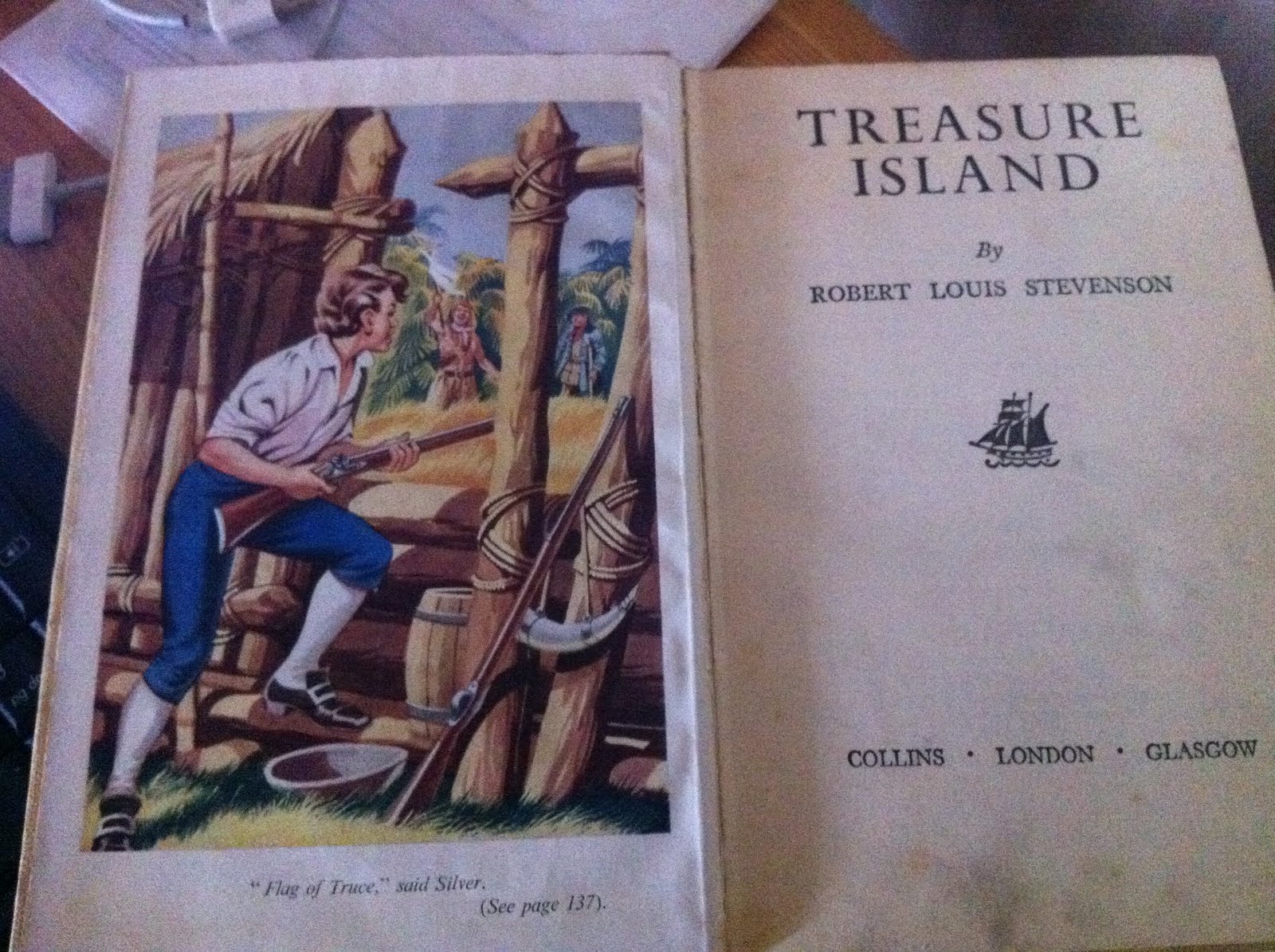
Treasure Island by Robert Louis Stevenson (Cassell and Company: 1883). The tale of a boy who comes into possession of a treasure map, and is whisked away by the adults in his life to try and find the hidden riches. All is not as it seems though, and when double-crossing pirates lead the adventure down a deadly path, it’s up to Jim Hawkins to find a way out.

A few admissions first off this week.
My name’s Gavin, and (as much as I try not to be) I can be a little pretentious sometimes. I know, you're shocked, right?
It’s a trait that leads me towards books that I think might look good on my bookshelf rather than books I actually want to read. It’s a weakness that has seen me trudge through some pretty dull books, but it’s also a trait that has meant I’ve found enjoyment in some classics – the kind of books you’re always told everyone should have read before they die.
It was that occasional drift towards pretension that first led me to Robert Louis Stevenson. That and the fact that he’s maybe the most famous Scots writer that ever lived. It led me initially to Kidnapped, which I really (really) enjoyed. Then it led me to Catriona, which I really (really) did not enjoy.
Then I left Stevenson alone for a bit (which I’m sure he cares greatly about whilst he’s living it up upstairs). But whilst browsing through the paperbacks at the bookstall of the Gateshead Family Fun Day this year (a stall attentively staffed by your friend and mine “the” Andrew Walton), I found this. A rather beat up, weathered version of perhaps the greatest adventure book of all time.
And, after a good few months where I thought I’d shaken it off for good, my pretentious streak kicked back in. Here was a 60-odd year old copy of an indisputable classic (albeit a children’s classic), available for 50p.
I nabbed it. And have spent the past week or so reading it.
Treasure Island - the name immediately puts images of sundrenched wildernesses in your head, and makes you taste a little sea salt in the air. And I greatly enjoyed the Muppets version - I'm sure you did too. So it’s true to say I opened the first page already pretty predisposed to liking this.
And, to a large extent, it didn’t disappoint. The story is over a hundred years old, but it’s aged well. It was written for kids, so the pace and structure are faster moving than most hundred year old novels. The language is a little intricate in places, and the scene setting is often filled a little too much with the type of jargon that may have been understandable to people in an age when ships were everywhere, but that is a little less commonplace in the age of easyJet. But it doesn’t matter too much. I did get bogged down once or twice, but for the most part, the story skips along, and it’s very easy to skip along with it.
The dialogue is by far and a way the best part of Treasure Island. Long John Silver has a voice and a nature that’s incredibly seductive. The guy is one of the great characters. His reputation preceded him before I ever opened the book, and meeting the man first hand was no disappointment.
But it’s not a one man show. The other characters make sure the pages are filled with personality and colour. Yes, they’re all a little hammed up, but I love that. Silver is the witty lovable sea-dog through and through - Jim Hawkins is the principled young hero to the end - Doctor Livesey never wavers from being the resourceful paternal figure – Captain Smollett remains true to King and country in all circumstances. The entire make-up of these guys can be summed up in a few words each. It means that they rarely achieve any depth or real-world qualities, but it also means they are highly entertaining.
So how do you score Treasure Island? How do you give a classic book like this one an out-of-ten number? How do you judge a story that has earned a Muppet parody?
7 GBR
That’s how.
I enjoyed this. It was entertaining and I’m glad I’ve now read it. But I’ve read better books this year, or rather books that I’ve enjoyed more.
Next week, time to shake off the pretension and go for one of those books that everyone on the train seems to be reading.

Sunday, 3 July 2011

And the Band Played On - real good stuff

And the Band Played On by Christopher Ward (Hodder & Stoughton: 2011) The story of what happened after the Titanic went down, focussed on the family feuds that one of the young members of the Titanic band left behind. Set largely in Dumfries, the family’s tale after the boat sank is a tragic one. The author is the grandson of the musician, and in writing this book, he’s forced to face some uncomfortable truths about his relatives.

The thing about real life stories is that they happened in real life. None of this “based on a true story” crap. None of this “some scenes have been staged for dramatic effect” nonsense. Reality TV can only take you so far. For me (and for many of you too I’d imagine) history is where it’s at. Honest to goodness, this-really-happened, history.

After we leave school, it’s pretty easy to forget. In truth, even when we’re at school, history misses the mark more often than it hits it. The same topics can be churned through too many times, and the pressure to actually remember what you’re being taught renders it ever so slightly boring.

And then books like this fall in your lap. And you start to catch the history bug again.

As history goes, this is fairly old ground. Everyone knows about the Titanic. You know the one - big ship, hit an ice-berg, sank in the Atlantic.  You might even know some of the smaller details - the fact that the whole “women and children first” idea came from the Titanic. And then there’s the detail that kicks off this book. The fact that the band played on the deck of the ship as it was going down, trying to bring a bit of calm to the situation as people fled for their lives. And then the families of the band were sent a bill for their lost uniforms after they drowned.

And it’s that kind of detail that makes books like this worth reading. The little ones. The ones that have real people’s faces behind them,

I don’t want to go on about it, but this stuff really happened. It’s as real as the people around you right now. These people lived this story, and then they died, and then we came along. The lines between us and them are, in the grand scheme of things, pretty small. For me, that makes any story compelling. This one is no different.

Of course, there are down sides. The pace dipped every now and then, and I had to remind myself of the reality of this stuff to make sure I stayed interested. There are parts where there’s a little too much conjecture, a little too much “I don’t know exactly what happened, but it was probably…”

But for a history book, it avoided a lot of the usual traps. The people he talks about are huge characters, just huge. Their personalities are compelling, almost to the point of being caricatures in some places. And the book has the feel of a story - the kind that a lot of history books just don’t. It never feels like a text book. It has the structure of a fiction book.

So yeah, I enjoyed this. I felt better for having read it. It probably won’t make my top ten books of the year, but it won’t be too far behind.

7 GBR

Another sit-on-the-fence 7 I’m afraid, but this was never going to be anything other. 6 seems harsh. 8 seems a smidge too much.

Next week, some popular philosophy. I bet you're looking forward to that one.

Sunday, 26 June 2011

Fear and Loathing in Las Vegas - surprisingly me

Fear and Loathing in Las Vegas by Hunter S. Thompson (Random House: 1971). A tour through Las Vegas fuelled by a car load of an impressive variety of drugs. Seen through the eyes of a journalist and his unstable Samoan lawyer.

I'm back after a week long hiatus. I'm sure you missed me. I certainly missed you. And this week's post comes from a hotel room in Lincoln in the middle of a wedding/christening double header of a weekend. Fast times.

And to ease me back in, the story of an altogether different weekend.

I don't mind admitting that this one scared me a little. I've had it in the back of my mind for a while as one that I wanted to read. But I was worried I wouldn't get it. This is, after all, the granddaddy of Gonzo journalism. I worried it would be just a little too off the wall for me. I worried that, frankly, it would be way too psychedelic for me. I'm not exactly (let's face it) cool. And this book is. So, odd as it sounds, I was a little concerned that it would sit there in my hands, staring back up at me screaming "come on now, who are you kidding, square?"

But, turns out, I'm more hip than I thought. (That's right, isn't it? The kids still say "hip"?)

Some of my expectations were, of course, met. There were a lot of drugs going on. The story took more than a handful of violent left turns. There were sections where I wasn't quite sure what was real and what was in the imagination of the narrator. The book and the trip it details takes you right to the edge of comprehension in places, but it never entirely leaves you behind. It's mad, and it's crazy, and it's disjointed, but it's also readable and entertaining and (in places) incredibly enlightening.

That was one of the pleasant surprises in fact. This book had some genuine "hmm, really makes you think" moments. It wasn't all just furious, fast paced drug trip. There was some thought folded in with the insanity. Quite a lot of it in fact.

All of which actually left me a little disappointed. Like finding out that the big bad wolf is a ninny. This incredibly cool book that I always thought would simply be on another plane to me was, in fact, not quite the mind bending odyssey I thought it would be. It was, instead, a bloomin good read.

And that's the conflict I'm dealing with here. The whole thing has been demystified for me a little now. I've joined the club and suddenly found out that it's not quite as exclusive as I thought it was.

Can I mark down a book for being enjoyable? Can I give it a low score just because it actually succeeded in connecting with me?

7 GBR

No, of course I can't. This book surprised me. I enjoyed it. I think it's a great book. Just not quite as cool as I used to think. But still, go read it.

I, however, may very well be way cooler than I gave myself credit for.

No, I don't think so either.

Sunday, 1 May 2011

In Praise of Savagery - good writing vs the real world

In Praise of Savagery by Warwick Cairns (The Friday Project, 2011) A novel describing the adventure of Wilfred Thesinger as he attempted to be the first man to chart a certain river in Africa; a river that was surrounded by tribes renowned for killing everyone that had tried to follow it previously. The author followed in his footsteps decades later.
First and foremost, huge congratulations to Gateshead RFC on winning the league in dramatic circumstances yesterday. Hugely deserved.
In celebration of a heroic achievement, a look at a book that follows another one.
I have a habit of underlining sentences or passages in books that I particularly enjoy. The words that scream out of the rest of the page and make you pause a little. It doesn’t happen in every book, and rarely more than a couple of times in a single book. But when it does, I like to mark it. I like to think I’ll go back to it one day and remember the effect it had on me the first time. In reality, it’s probably just a little bit of a pretentious tick. (Insert obvious joke here).
Either way, this book presented me with a bit of an "underlining" problem. About half way through, I hit upon about three pages, all of which jumped out and made me stop to think. No other way to put it – it was just beautiful. Effortlessly beautiful. And of course, I couldn’t underline all three pages. Damnit.
Luckily, that wasn’t the only great passage in the book. I underlined a couple of other, shorter ones instead.
Warwick Cairns writes incredibly well. He doesn’t simply tell you what happens, he uses his experiences to spark off tangents that you end up willingly riding along on. He packs the book with these tangents, each of which brings into life an entirely new area of thought. Because of this, the book stays fresh throughout.
In fact, I’d go as far as to say the story ended up getting in the way a little. I loved the detours Cairns took in his writing, but when he re-centred onto the story itself, I found myself drifting a little. There’s no doubt that Thesinger is an amazing man who did amazing things, but I found the descriptions of his journey and of Cairns’ own adventures a little static. A list of thing that happened, one after the other.
Perhaps it suffered a little from the richness of the detours. When placed next to Cairns’ wandering mind, the pedestrian pace of just describing stuff that happened became a little frustrating. It’s a tough criticism. Cairns couldn’t simply write 200-odd pages of “stuff that I think.” At some stage, he needed to put “stuff that happened” in there. And the material he chooses is pretty spectacular. But for me, it didn’t really hold me interest. I sped through those bits, waiting for another detour.
So a massive positive tick for his writing style and his imaginative tangents, but an important caveat in the rather less inspiring real world descriptions. Together, that makes...
7 GBR
Classic sit on the fence score. It’s a good book, and it’s well written, and I enjoyed it. I’ll probably go back and have a flick through some of the more sparky pages at some stage. But I can’t help but think it could have been a lot better.

p.s. a special thanks to my secret source that helped me get hold of the paperback version of this book ahead of publication.

Sunday, 20 March 2011

The Gargoyle - just get past the "love" bit

The Gargoyle by Andrew Davidson. (Canongate Books: 2008) An epic story following the redemptive experiences of a burn victim after he meets a delusional sculptor who professes to have known him in a previous life.
A book touted on the front cover as a “romance”. Strike one
A big sticker proclaiming it as a recommendation from the Richard and Judy book club. Strike two.
A first sentence that reads Accidents ambush the unsuspecting often, violently, just like love. Strike three.
Ordinarily, I wouldn’t touch this book. But it was recommended to me by two people whose taste I trust. And something about judging books by their covers (and the inadvisability of such a course) started ringing in my ears once I was presented with a copy of it.
So I decided to take a deep breath and give it a go.
I often worry that a large part of enjoying a book is where you read it and the time you have with it. I read much of The Gargoyle in three or four hour spurts, quietly in my living room (which is one of my favourite places). Reading a book in a place that gives you the space and the peace to really read it always seems to make it better.
I said I worry about this. Because the inverse is true too. I worry that I’ve missed the point of some great books because I read them mostly in ten minute spurts between stations. I worry that I like some very average books more than some amazing ones because I read them on a beach, far away from an office.
But, good thing or bad thing, I read this book in a good place. And I enjoyed it.
There are plenty of reasons why I shouldn’t have. It’s not that the idea of love bores me. I’m very much in love myself. It’s just that artistic representations of it tend to take a wrong turn somewhere and end up in Gooey-ville.
To an extent, my initial fears were proven justified. It is indeed a love story. And I can certainly picture Richard and Judy talking it over on the couch.
But let’s get past why I shouldn’t have enjoyed this and explain why I did (and why I think you will too). This book is about 500 pages long, and there was plenty of time for it to win me over.
It’s a thoroughly well thought out story. In fact, it’s about six or seven well thought out stories. The way they interplay with each other is clever. The way the true, central story is slowly revealed is expertly achieved. It’s a long book, but I didn’t feel its length until I’d turned the last page and realised just how enveloped it The Gargoyle world I had become. Yes, the love becomes a little eye-roll-tastic sometimes, but on the whole it had me feeling more empathy than scepticism.
And it’s this guy’s first book. Which makes me more than a little jealous. It’s wildly ambitious. This guy wasn’t just trying to knock out 250 pages and get a stake in the ground for his career as a novelist. I know nothing about him, how he managed to pour so much into a book like this, how the bills were paid in the meantime, but it must have taken a great deal of belief in his talents. And it’s belief that wasn’t misplaced.
So, worthwhile of your time? Worth picking up and dedicating a few hours to?
7 GBR
Yes.
7’s a score I tend to try and stay away from. It’s the ultimate sit-on-the fence score. It’s “I really liked it, but I’m not about to buy the t-shirt”. I enjoyed reading it. And I’m glad I did. It suppressed the stoic Brit in me for a couple of weeks. But he’s back. And he’s finding it difficult to reach above a 7 for a love story right now.

Sunday, 9 January 2011

Wolf Hall - you get out what you put in...

Wolf Hall by Hillary Mantel (Fourth Estate: 2009). A historical novel following Thomas Cromwell as he rises from low born Londoner to the most powerful man in Henry VIII’s court. It charts history as the King splits from the Catholic Church, marries Anne Boleyn, and condemns Thomas More.

650 pages worth of Booker Prize winning historical fiction. Be still my beating heart...
I know, historical fiction often ends up lumped in with science fiction in the ever-so-slightly-too­-geeky category, but I’m a fan. So when Wolf Hall came up on my “Amazon recommends” list, it was an easy decision.
Now, in the vein of the principles of GBR, I’m going to try and take as objective a view of this as I can. I'll even spare you the historiography, and focus simply on the merits of the book as something worth spending your time on. It’s not “did I enjoy it,” but “do I think you’ll enjoy it?”
I think you will. And here’s why.
This is an incredibly rich book. It’s a novel that makes you remember how fulfilling reading a book can be if you give it enough of a chance.
It’s long, has lots of characters, and meanders its way through the life of the protagonist (Thomas Cromwell), and so I’ll be honest, my attention drifted at times. But it seemed that whenever I was in a quiet place with it, it excited me, enlightened me, saddened me, or amused me. Mantel had a lot to say, and she said it all very well.
And it’s not just the way she’s woven the story, it’s the way she writes that also sets this book apart. She includes a handful of intentional quirks of style that make the book enjoyable to read. It’s as if you’re getting used to the way someone speaks, and once you do you feel a bond with them. The book becomes individual and unique.
Mantel takes you into the pages of the book and makes you feel included in them; she trusts you to infer parts of the story. She builds the narrative as much through explicit explanation as by mutual understanding with the reader. It’s a rare skill, and one that makes Wolf Hall difficult to put down – after all, how can you put down something that you’re playing a role in creating?
What about downsides? Well, if you know anything about your history, you can forget about any major twists in the storyline. By focussing on such public figures, Mantel forgoes any hope of really surprising the reader with a big reveal or an unexpected turn. Not that it seems to matter.
Mantel is also a little clumsy in her portrayal of Jane Seymour. Knowing she plays such a huge part in the story of Henry VIII (albeit after the timeline of Wolf Hall,) it’s a little frustrating not to hear more from her. Not that that seems to matter either.
The only thing that may matter in the debit column is the sheer ambition of the book. It’s long. And it covers a lot of ground. And so it shouldn’t be picked up as a casual read. It requires you to invest a little in it, which (as I’ve said) is a big strength, but can also be a little tiring when you just want to kick back and rattle through a few pages.
So where do we end up? A brilliant book, that makes you feel good about reading, but could also make you feel in need of a nap at times. The sum total is a score of...
7 GBR
Definitely a book worth spending your time on, but only if you have quite a bit of it to spend. Now I’ve finished it, I’m off to watch something mindless on TV.
Buffy, anyone?