Sunday, 25 September 2011

Misery - not such a bad emotion

Misery by Stephen King (Hodder and Stoughton: 1987). Classic King, centring on a writer who is kidnapped by his psycho number one fan, who takes him to hell and back as she forces him to turn out one last book in a series that he’s come to hate.
Well, this feels apt. Right after going through an emotional roller coaster watching Scotland give a traditional so-close-yet-so-far performance against Argentina, here I am reviewing a book called Misery. Yeah, that pretty much sums up it up.
That’s life though I guess. Emotion followed by emotion. It’s why we follow sports – to buy in to the highs and the lows. It’s why we go on roller coasters and ghost trains – to tap into a little bit of terror. And it’s why we read book (to some extent) – to be made to feel something by the words on the page.
And most of the time, it’s those negative emotions that we chase the most. Tension. Anxiety. Heart break. Fear.
Which brings me nicely on to Stephen King. There’s a guy that knows how to stir up a nice big pot of fear. He’s done it I don’t know how many times, and he does it again here.
It’s the way he builds his stories that really sets him apart. Misery starts with a pretty terrifying situation. Not too many pages go by before you grasp the situation at hand. Where some writers would build up it up gradually, King lands you right in there and then spends the rest of the (fairly long book) building on it and building on it. He creates honest to goodness fear not by lulling you into a false sense of security then shocking you. Instead, he explores a horrific situation so completely that you’re locked inside it.
He goes off on enough tangents to give you a breather, to let you learn about the characters (all two of them), to put the fear into context. But he never lets you completely escape.
I kind of enjoyed how dated the book is as well. There are a few cultural references that remind you that this book was written in the 80s (none more so than the prominent  typewriter). But it’s more than just the references, it’s the way it’s written too. It just sounds 1980s. It’s like watching The Goonies. And I love that about it.
Main area the book falls down in? It’s the area most horror stories fall down in. (Ever so slight spoiler alert here – not really though. I knew I said I wouldn’t do spoilers, but hard to make this point without it). You knew all the way through that everything would turn out alright. There were one or two moments you started doubting it a little, but King never really makes you believe the absolute worst could actually happen. You always knew that the psycho wouldn’t win.
Otherwise, this was great. But then we all knew it would be, right? It’s Stephen freakin’ King. No surprise the guy can write. No surprise he can craft a good story. He’s done it dozens of times.
9 GBR
When you fancy reading a good book and don’t know where to turn, pick up a King. Dead cert every time.
Also, a quick note on my copy of this book. I got it as a FlipBack book – a teeny tiny book smaller than your phone (unless you're my dad), with the pages in landscape rather than portrait. Cigarette paper thin pages. You can fit it in your pocket, and you get used to the way it’s printed pretty darn fast. I’m a fan.
Next week, another claustrophobic one about people who spend most of their time in one room. Bit of a theme developing here, huh?

Sunday, 18 September 2011

The Help - smashing through roadblocks

The Help by Kathryn Stockett (Fig Tree: 2009). The story of Jackson Mississippi in 1962, where the race lines were still very clearly drawn. It focuses on the black home help that most of the white community employed, portraying both the brutal and the heart warming sides.  
There are a lot of reasons (good and bad) why I should not like this book. So many in fact, I’m going to use bullet points to take you through just a few of them (that’s right, bullet points on a Sunday, I bet you thought I wouldn’t go there. Well, I did).
·         Tons of people I know have read it and love it (including my wife). This means taking on a massive risk – what happens if I read it, don’t like it, and have to say so on this here blog? Arguments, that’s what.
·         It’s about a pretty over done topic. It’s essentially a civil rights book. Not that that’s a bad thing. In fact, it’s a wonderful and vital thing. Just a thing that’s been done a few times before. It’s the same reason I try to avoid WWII books now. I’ve heard that story before.
·         It’s full of accented speech. Again, not a bad thing in its own right, just a very difficult thing to write in a way that doesn’t become incredibly hard work to read.
I’ll stop at three; the bullet points are making me feel nauseous.
So I was fairly resolved not to read this. But then I realised I write a blog about books now, and one of the big motivators behind it is to read stuff I wouldn’t ordinarily. Broaden the old horizons a little. And sometimes that means reading the multi-million bestselling, Hollywood blockbusting, talk of the masses book.
All of which, thankfully, gets left behind as soon as you start reading this. Books frequently have the ability to make you forget that they’re being read by millions of others. Make you forget that they drive mega entertainment industries. Make you forget that they’re at the core of smash hit movies. Make you forget that they’re in any way commercial at all.
Good books grab you and speak with you and make you feel the only things in the room are you and it.
And so it is with The Help. Every roadblock I threw up to liking this book was driven through within a couple of chapters. And it was for no other reason than it was just incredibly well written. This is an easy book to sink into. It presents a world and people in it that you quickly become familiar with, and one in which you’re quite happy to live in for long periods of time.
Whilst driving through the roadblocks I’d put up for it though, the book picked up a few new scratches along the way. It centres on three core characters, and hops between them throughout the book. It’s a structure that was quite fun to begin with, but as it went on, the lines between the characters started to blur, and the constant hopping between their perspectives didn’t so much keep the story sharp as it frustrated any sense of continuity.
Also, the overarching plot began to drag a little. And if there’s one thing that can ruin an otherwise great book, it’s a draggy plot.
None of the scratches obscured what I liked about the book too much though. It’s hugely enjoyable to read. And it’s rich as well. There are so many little spirals, little strands of storyline, little insights to different parts of the community and the different lives in it. I can’t decide if the fact that they’re put together in a bit of a chaotic way is a good thing or a bad thing, but I can’t deny that I enjoyed reading them.
Which I is the whole point of this blog. I said at the start that I wasn’t going to judge whether books were “good” or not. “Good” has far too many ways to be interpreted. Instead, it’s all about was the book “enjoyable”. Is it worth your time? Will it be more fun than whatever’s on telly?
7 GBR
Yes on all counts.
Very very good, but not brilliant. It forced me to get past the reasons why I thought I wouldn’t like it. I enjoyed living with it for a couple of weeks, and I always picked it up with relish. But I probably won’t look at it fondly on my bookshelf. And I probably won’t go see the film.
Next week, the second horror story of the year for GBR.

Sunday, 11 September 2011

Last Exit to Brooklyn - a bit of a Julia Roberts

Last Exit to Brooklyn by Hubert Selby Jr (Calder and Boyars: 1967). A book that was initially banned for its obscenity in 1967, it’s set in the gutters of New York City and follows a cast that embody all that is not well about America. It explores most of the bad sides of human nature and some of the good, and sparks sympathy for the unlikeliest of characters caught in bad situations.
Hi guys.
I’ve spent the last two weeks trying to finish a book that just doesn’t want to be finished. It’s not its fault, it’s entirely mine. It’s a pretty good book, but for one reason or another, I’ve ended up reading it in snatched five minutes here and there.
So instead of reviewing what I wanted to review this week, I’ve ended up staring at my bookshelf looking for an old read that is worthwhile telling you about. And I settled on Last Exit to Brooklyn.
And it’s for one very specific reason. This is one of the few books that, regardless of the setting in which I read it, sucked.
Julia Roberts - I don't like her, but you might (idiot)
I like to think I’m fairly generous of mind. Pretty open to new things. If I don’t like something, I try to at least recognise why someone else might. I hate Julia Roberts’ films for instance, but I get that some people might find her funny and pretty and deep and all that stuff. I don’t. I think she’s rubbish. But I can see why you might think she’s not.
Last Exit to Brooklyn, though, I just don’t get. I picked it up in the first place for a few reasons. First – I’m a big fan of America, and New York in particular. I think it’s probably one of the best cities on earth, and one of the biggest and best muse’s the world’s ever created. Second – this is supposed to be a major modern classic. In the words of one reviewer, it will “still be eagerly read in 100 years time.” That intrigued me. I like the idea of books that survive.
So I was looking forward to this.
But it just did not work for me. It’s written in an incredibly distinctive way. It’s been lauded for its poetic qualities. It has a pace and a feel that is intent on carrying you along with it. Selby didn’t just sit down and start describing the stuff he wanted to – he chose the structure of his sentences and his paragraphs and his chapters in such a way as to create a fierce rhythm.
I tried, honest I tried. I tried reading it in short bursts. I tried reading it in quiet places. I tried reading it in loud places. I tried reading it the right way up and upside down (OK, I didn’t do that). But I just did not get it.
OK, I understand it’s supposed to be pretty chaotic. I understand it’s supposed to be uncomfortable to read. But I’ve read psychedelic books, and I’ve read disturbing books, and I got through them fine. This, I struggled with. The stream of consciousness style meant I just never found anything to anchor my interest on.
The sad thing is that the characters and the setting are pretty amazing. The New York that’s being described is a version that really does compel me. The characters that Selby jumps between really are wonderful and complex. The point that Selby is trying to thrust home with every breath of the book is important, but for me, it’s simply lost in the utter confusion.
I know the style of the book is supposed to reflect the depravity and disorder of the world that Selby is presenting. But instead of making me truly feel the spirit of the book, it just ended up making me bored.
Words are a wonderful thing. Instead of using them for their meaning, Selby uses them for their rhythm. Which could work in poetry, but for a novel, it just ends up in a creation that you need your dad’s size 14 wellington boots to wade through.
3 GBR
I didn’t enjoy this. But I can’t give it a zero. I get that it’s an important book. And I still get excited by its premise. Maybe I need to pick it up again and see if it makes more sense with a second run. I probably won’t though. It’s rugby world cup month, so I have better things to do with my time than read a book again that I didn’t enjoy first time around
Next time, the book that I’ve been trying to finish for ages. I promise.

Friday, 2 September 2011

A week worth missing


Just a warning for those of you whose Sunday mornings are defined by reading a brand spanking new GBR book review - prepare for disappointment this weekend.

I plan to miss just my fourth Sunday all year. The excuse? It's my anniversary this weekend (2 years and counting...). I have it all planned out, and I'm afraid there'll be no room for blogging on Sunday morning.

I'd tell you what I have planned, but then I'd have to kill you - my wife has been asking about it for like a month, so she should probably know before you (she did ask first, to be fair).

Don't worry, I promise to do something equally special for you on our anniversary.

On another note, good luck to Ben and Doran, who are tying the knot on Sunday themselves. About bloomin time too. I promise not to steal too much of the limelight with my wicked cool dance moves.

Sunday, 28 August 2011

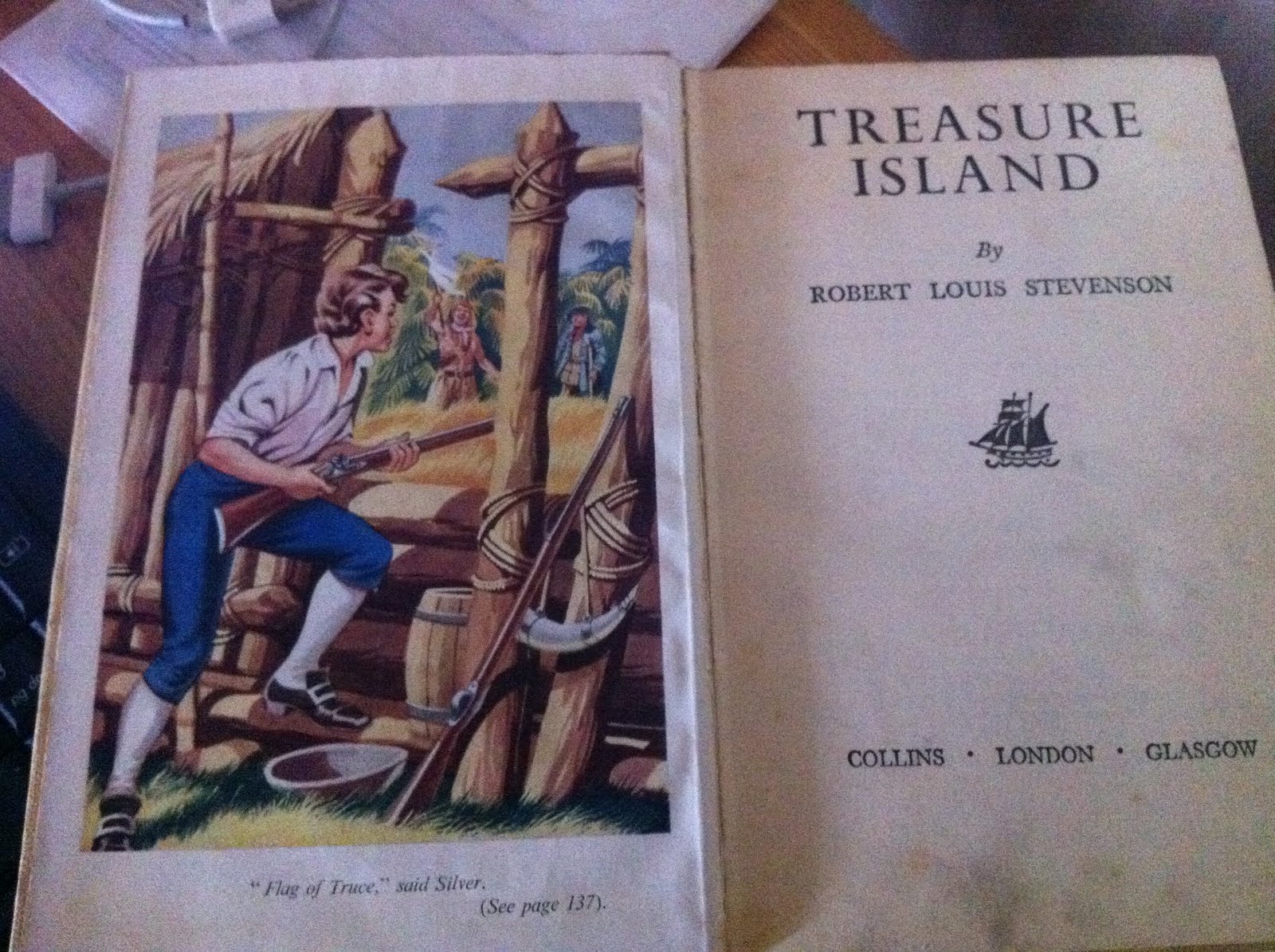
Treasure Island - rum fuelled fun

Treasure Island by Robert Louis Stevenson (Cassell and Company: 1883). The tale of a boy who comes into possession of a treasure map, and is whisked away by the adults in his life to try and find the hidden riches. All is not as it seems though, and when double-crossing pirates lead the adventure down a deadly path, it’s up to Jim Hawkins to find a way out.

A few admissions first off this week.
My name’s Gavin, and (as much as I try not to be) I can be a little pretentious sometimes. I know, you're shocked, right?
It’s a trait that leads me towards books that I think might look good on my bookshelf rather than books I actually want to read. It’s a weakness that has seen me trudge through some pretty dull books, but it’s also a trait that has meant I’ve found enjoyment in some classics – the kind of books you’re always told everyone should have read before they die.
It was that occasional drift towards pretension that first led me to Robert Louis Stevenson. That and the fact that he’s maybe the most famous Scots writer that ever lived. It led me initially to Kidnapped, which I really (really) enjoyed. Then it led me to Catriona, which I really (really) did not enjoy.
Then I left Stevenson alone for a bit (which I’m sure he cares greatly about whilst he’s living it up upstairs). But whilst browsing through the paperbacks at the bookstall of the Gateshead Family Fun Day this year (a stall attentively staffed by your friend and mine “the” Andrew Walton), I found this. A rather beat up, weathered version of perhaps the greatest adventure book of all time.
And, after a good few months where I thought I’d shaken it off for good, my pretentious streak kicked back in. Here was a 60-odd year old copy of an indisputable classic (albeit a children’s classic), available for 50p.
I nabbed it. And have spent the past week or so reading it.
Treasure Island - the name immediately puts images of sundrenched wildernesses in your head, and makes you taste a little sea salt in the air. And I greatly enjoyed the Muppets version - I'm sure you did too. So it’s true to say I opened the first page already pretty predisposed to liking this.
And, to a large extent, it didn’t disappoint. The story is over a hundred years old, but it’s aged well. It was written for kids, so the pace and structure are faster moving than most hundred year old novels. The language is a little intricate in places, and the scene setting is often filled a little too much with the type of jargon that may have been understandable to people in an age when ships were everywhere, but that is a little less commonplace in the age of easyJet. But it doesn’t matter too much. I did get bogged down once or twice, but for the most part, the story skips along, and it’s very easy to skip along with it.
The dialogue is by far and a way the best part of Treasure Island. Long John Silver has a voice and a nature that’s incredibly seductive. The guy is one of the great characters. His reputation preceded him before I ever opened the book, and meeting the man first hand was no disappointment.
But it’s not a one man show. The other characters make sure the pages are filled with personality and colour. Yes, they’re all a little hammed up, but I love that. Silver is the witty lovable sea-dog through and through - Jim Hawkins is the principled young hero to the end - Doctor Livesey never wavers from being the resourceful paternal figure – Captain Smollett remains true to King and country in all circumstances. The entire make-up of these guys can be summed up in a few words each. It means that they rarely achieve any depth or real-world qualities, but it also means they are highly entertaining.
So how do you score Treasure Island? How do you give a classic book like this one an out-of-ten number? How do you judge a story that has earned a Muppet parody?
7 GBR
That’s how.
I enjoyed this. It was entertaining and I’m glad I’ve now read it. But I’ve read better books this year, or rather books that I’ve enjoyed more.
Next week, time to shake off the pretension and go for one of those books that everyone on the train seems to be reading.

Sunday, 21 August 2011

Cream Teas Traffic Jams and Sunburn - a bit of a surprise

Cream Teas, Traffic Jams andSunburn, by Brian Viner (Simon & Schuster: 2011) Brian Viner blends his own experiences with those of his family, friends and acquaintances to explore the cultural phenomenon of the British on holiday. Using anecdotes, history, and his own keen observations, Viner shines a light on why we do what we do when we're at leisure, from Bognor Regis to Beunos Aries.

Choosing books to read is a minefield. One which, with a bit of time and the odd lost leg, most of us like to think we can navigate fairly well. As much as we’re urged not to judge a book by its cover, most of us do to some extent. Not literally, but we usually let a handful of initial signifiers dictate whether or not we pick a book up.

Genre. Author. Reviews. Recommendations. The title. The blurb on the back. Tick one or two of those boxes, and you’ll probably pick it up.

Which is why I was fairly sure I was going to hate this book. From all I could tell, I thought it’d essentially be the book version of one of those painful TV shows where they get a bunch of tv “celebs” to talk to camera about how mad the ‘80s were. I thought it’d be full of “aren’t we crazy” moments. I thought it’d rely heavily on having a reader who is prone to chuckling internally with a “that is so like my Aunt Ida” thought. In short, I thought it’d be pretty vacuous.

But it was free. And I try to keep an open mind. So I gave it a try.

And it proved me wrong.

The main thing it had going for it was the wit of Brian Viner. Wit can take you a long way, and Viner has it in spades. And he uses it to good effect, carefully avoiding too much of a “isn’t it funny when…” tone by telling his anecdotes with genuine good humour. That I did end up accidentally feeling an affinity for his experiences (and those of his seemingly hundreds of interesting friends) is testament to how well this is written. I opened the first page determined not to succumb to what I though would be a sickeningly chummy narrative, and I closed the last page wanting to go round his house for dinner.

And it’s not just his wit that turned me around. He brings some good history into the book as well, charting the course of the holiday as a phenomenon and introducing the pioneers who, through the centuries, have defined how we spend our leisure time (that is, once the world’s workers had some of it to spend).

There are some genuinely interesting facts and figures in here. Just ask my wife. She suffered through a week of me starting sentences with “did you know that…”. She smiled sweetly throughout, (she’s a trooper like that), but I know it’s annoying when someone keeps bugging you about stuff they’ve just read in their new book. Again, the fact I ended up feeling compelled to share what I was reading then and there goes some way to show just how much this book won me over.

But, to be fair, I had a long way to go. I started convinced that I was going to hate this book. Its wit and its history meant that I didn’t. But not hating it and actively liking it are two quite different things.

The wit can only take you so far. It took me to about two hundred pages before it started to wear thin. If he’d stopped the book there, I probably would have scored this pretty darn high. But he didn’t - Viner went on for another 100 or so pages. And (I’m sad to say) it just got a bit sameish after that. I’m not sure if the best anecdotes are packed in at the start of the book, or if I just got a bit bored. Either way, the book rather peaked and then declined fast.

And there were one or two aspects that I didn’t really notice at the start of the book, but that started to bug me by the end. One was the unfeasible amount of holidays Viner seems to take. I know this is a man who, through his job, has the opportunity to travel a fair amount, but he seems to pack in a dozen breaks a year to various destinations. True, they’re not all far flung and exotic, but they are numerous. By the end, all I could feel was slight depression that I don’t get away anywhere near the same amount.

The other slight annoying aspect was the sheer number of “close friends” Viner references. Every page details the story of another set of “close friends” and their experiences, more often than not whilst on holiday with Viner and/or his own family. The cumulative impression is of a man who spends all of his time on eventful holidays with hundreds of his closest friends. And that isn’t a man I can really identify with, which is important when it’s his voice you’re listening to throughout the book.

So, to the score. How does a…

6 GBR

…grab you?

A rollercoaster of emotions for the week. Hating it one second, loving it the next, then bottoming out at something just above indifference.

Next week, something a bit more established. The second young adult book of GBR history, though of a different era than the first. Intrigued? You should be.

Sunday, 14 August 2011

The Stranger's Child - a different type of great

The Stranger’s Child by Alan Hollinghurst (Picdor: 2011). An epic of a book, starting with a weekend gathering at a country house in the early 1900s, and following the reverberations of that weekend through the lives of those in attendance (both long and short). Jumping decades between chapters, and told from the perspective of a variety of characters, the book chronicles the changing attitudes of society, and how those changes shed differing lights on the lives people have lived.
Read enough books, and you start to get familiar with a few of the tools of the writer. The cliff hanger is probably one of the most used. The dramatic twist is another. A sudden change of pace. The introduction of a mysterious new character. You name the tool, most books have at least one or two of them in which you can spot the finger prints of the writer from a mile away.
For the most part, when they’re used well and the right groundwork precedes them, the tools work. They do their job of hooking you into the book and raising your heartbeat a little. But the basic weakness of all these tools is that they almost always remind you that you’re reading fiction. They remind you that some guy or some gal has sat down at a desk and thought “how can I make this bit of the book a bit more exciting?” They remind you that, behind this story, there’s a writer and an imagination and a pretence. I read a short guide on how to write by Elmore Leonard once, and his big point was that the ultimate aim of any writer is to make the reader forget that you exist.
By now, I bet you’re starting to wonder about the book this week. So I’ll get to it.
The Stranger’s Child is so absent of obvious writers’ tools that I really did forget that Alan Hollinghurst existed at times. It unfolds with huge credibility; it just trips along with the feel of a genuine tale. There’s a distinct lack of fireworks, no lazy screams of manufactured excitement. It’s just all laid out there on the pages, a (not so brief) history of a small collection of people.
In fact, some of the most dramatic events in the lives of the central characters are skipped over entirely. The story is left at one point and picked up ten, twenty or thirty years later, with the intervening period spanning wars, deaths, births and marriages, but none of this drama is exploited for added drama. Instead, they’re sacrificed in favour of focussing on more subtle but arguably more significant events.
This is a long book. A fairly pedestrian story. But one that I read with enthusiasm, committed to it not because of the car chase excitement, but because of its inherent plausibility, the believability of the characters, and the affinity I felt with them because of it. Hollinghurst has written a book that has a great deal of beauty; a beauty that is likely to endure because of its understated qualities.
Now, I’m nervous about the scoring here. Not a lot actually happens in this book. And it’s 500 pages worth of not a lot happening. To an extent, it asks you to give it a chance, to settle into the world it creates and appreciate it in its own right rather than for the twists and turns of a high adrenaline plot. Adrenaline is simply not here.
It’s not so much a Berocca of a book, more a soothing cup of tea – less exciting, but no less enjoyable.  
My worry with the GBR score is that the book comes with a heavy condition. Read it a couple of pages at a time, snatched here and there in amongst your otherwise busy (and, no doubt, glamorous) lives, and you’ll probably get bored with it. But give it the time and space that it needs, and I’m convinced that you’ll love this like I did.
So I’m going to trust you here.
9 GBR
It’s a different kind of 9GBR than previous ones. It’s achieved in a very different way. Pick this up if you have a bit of time to spend on it. If not, go for The Great Gatsby, I, Lucifer, or (of course) The World of Jeeves.
Another high score. Who knew a 500 page book in which not a lot actually happens could earn a 9GBR, huh? I’m going to have to try and read something bad next, or you’re start thinking I’m a pushover. Which I’m not. At least I don’t think so.
Next week, a surprising book about summer holidays. See you in seven days.